


What’s the cornerstone of great golf?
Belief.
You have to fully commit to your approach and trust that it will deliver results.
Of course, solid mechanics, consistent practice and physical fitness are also essential to performing at a high level. But without mental commitment, even perfect technique and preparation can fall short of unlocking your best performance on the course.

Easier said than done, though—how many times have you felt confident walking to your ball, only to stand up to the shot and feel your conviction disappear in an instant?
The human mind is complex, with thoughts constantly drifting in and out of our subconscious—some helpful, some distracting. This nonstop mental chatter can be difficult to manage without a clear, structured approach.
Fortunately, science-backed techniques exist that tap into a natural human gift: speech. We are hard-wired to connect with language, and with intentional vocal cues our brains can hack into the subconscious flow of random swing thoughts and turn them into a weapon on the course.
Sports psychologist Trevor Tellin, who brings decades of experience working with elite athletes, has harnessed this science to create an AI-based tool, InnerLoop Sports, that analyzes on-course chatter and translates it into actionable insights that can help sharpen your mental game.
Coach Trevor Tellin – A Sports Psychologist for the Common Golfer
Sports psychology is a discipline usually reserved for only the most elite athletes—over the past couple decades, every major sport has been transformed by the power of mental toughness.
“Coach Trev” has worked with hundreds of top athletes across various sports, and has developed a systematic approach to mental improvement centered on mindfulness and purposeful growth.
At the 2026 PGA Show, as I roamed the Inventors Spotlight section of the exhibition hall—home to some of the quirkiest innovations you’ll find in the game—I found Trevor’s booth and stopped to chat for 15 minutes. Unlike the flashy gadgets and accessories that dominate the Inventors Spotlight, his offering was completely intangible: a tool designed to strengthen your mental game.
Trevor’s enthusiastic, approachable nature instantly drew me in. His passion for sports psychology was clear, and I knew right away that InnerLoop Sports was something I wanted to try this season.

Trevor gave me a demonstration of his AI-based tool, and I was shocked to see how easy it is to use. Simply clip on a microphone during your round, record your entire session using a voice recorder app and then upload the audio file to the InnerLoop Sports website. Within minutes, you’ll receive detailed insights into your mental game.
InnerLoop – A Virtual Psychologist in the Palm of your Hand
Trevor has cooked up a way for all golfers to tap into the benefits of sports psychology, all from the palm of your hand and at a low cost. Skip the high billing rates of traditional sports psychologists—InnerLoop Sports delivers similar insights that can provide a roadmap to a strong mental game.
Sports Psychology as a discipline picked up steam in the 1980’s, and with decades of research and data, Trevor and his team built an AI-based model that will listen to what you say on the golf course and translate it into actionable insights, mere minutes after completing a round.
Specifically, Trevor called out one groundbreaking reserch paper that uncovered the connection between self-talk and athletic performance, laying the foundation for the InnerLoop algorithm:
“InnerLoop’s concept and scoring logic are built on established sport psychology research, most directly drawn from Self-Talk in Sport, edited by Alexander Latinjak and Antonis Hatzigeorgiadis — a comprehensive academic text compiling decades of research on how athletes’ internal and spoken self-talk affects performance. That book, along with supporting studies, shaped how InnerLoop defines and categorizes self-talk (spontaneous vs. goal-directed, instructional vs. motivational, positive vs. negative) and which metrics matter most.” – Trevor Tellin
Enhanced by additional academic studies in Sports Psychology, the model uses these research-supported categories to analyze real self-talk data recorded during a round. It employs AI to transcribe and categorize the speech, transforming academic concepts that were once evaluated through surveys or memory recall into a system that can be monitored in real time, shot by shot.

My Experience with InnerLoop
After Trevor passed me a microphone kit and instructions for uploading data, I was ready to kick off the season with virtual assistance to elevate my mindset on the course.
My first few rounds with InnerLoop Sports went smoothly, but I did need to carefully follow instruction to ensure the process would work as intended.
The first step is creating an account on the InnerLoop Sports website. With a 30-day free trial available, it’s an excellent opportunity to test the waters and see if it fits your game.
To record voice data, you’ll need to wear a small microphone throughout the round. For me, this was the biggest pain point—simply remembering to mic up before each round, and making it a part of my pre-golf routine.
Fortunately, there are a ton of low-cost options for wearable microphones and adapters on the web.
To capture on-course chatter, I used the native “Voice Memos” app on my iPhone. Just power your mic on and plug in the adapter, and start recording.
After the round, head to your InnerLoop Sports dashboard and select “New Round.” There, you’ll be prompted to upload the audio file.
Uploading only takes about a minute, and then the AI algorithm gets to work—delivering detailed data and insights within minutes.

Uploading a round to the InnerLoop Sports App 
Your new round will show up in the main dashboard while the analysis runs – takes only a minute or two! 
The main dashboard shows a summary of recent rounds recorded 
The Analysis page dives deep into specific observations about your mental state during the round
Interpreting Results
Heading into the 2026 season, I would’ve described my mental toughness in golf as “moderately strong.” Over the years, I’ve learned how to avoid blowups and maintain an even keel through the inevitable highs and lows of a round.
What I didn’t see, though, was a blind spot in my game—a decidedly neutral mindset, lacking the positive reinforcement that can turbocharge performance.
Turns out, as InnerLoop Sports revealed, my mental state is often in cruise control, the perfect environment for negative swing thoughts to creep in at exactly the wrong time.

As shown on the main feedback page above, the key metrics focus on the balance of positive, neutral and negative mindsets throughout the round.
With only 10% of my chatter categorized as “positive,” I lacked the consistent mental reinforcement necessary to perform at a high level.
Even more concerning was my slow recovery from negative moments. Dwelling on a bad shot for an average of 20 seconds was more than enough time to let self-doubt seep into the next swing.
One metric I particularly appreciated was the Profanity Count—with minimal cursing during the round, I felt I kept my composure well. In my experience, rounds where I start freely dropping F-bombs usually signal a truly rough day on the course.
Another feature I find fascinating is the “Segment Breakdown,” which tracks your mood sequentially from the 1st tee to the 18th green.
The Segment Breakdown reveals how your mindset shifts during the round, telling a vivid story of mental resilience or struggle. The chart below captures one of my worst rounds of the season—a beautiful evening at Bishops Bay Country Club, where the tranquil surroundings contrasted sharply with my performance.
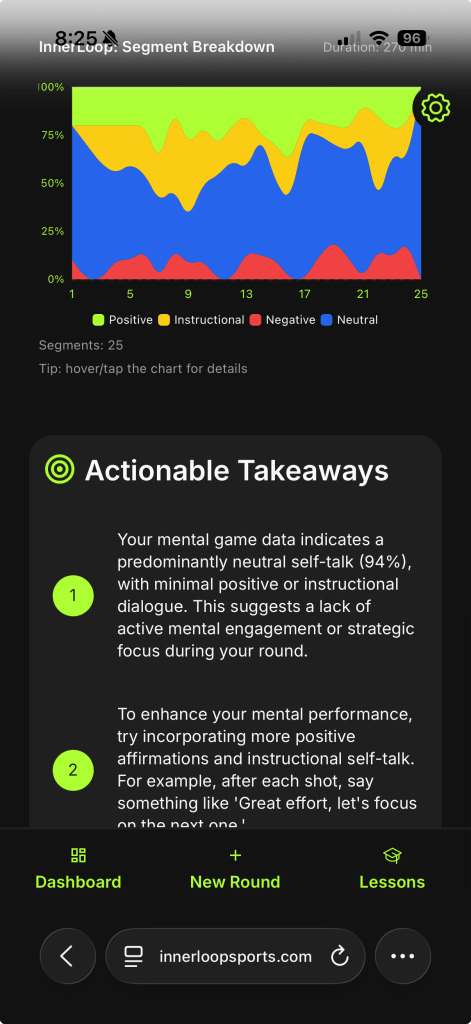

After a fairly solid start over the first four holes, I hit a rough patch with three consecutive double bogeys. The Segment Breakdown suggests my vocal cues shifted to “Instructional” around that time—not surprising, since my timing and tempo were off and I clearly needed a technical reset.
Nothing seemed to be working that day, though, and I felt like I had to work hard for every bogey. Then, things really went off the rails on the back nine and positive self-talk vanished, illustrating how easily my focus slipped once I realized a good score was out of reach.
What InnerLoop Sports highlighted is that positivity matters—even on your worst days. If I had kept prompting myself with positive thoughts, I might have salvaged a score in the high 80s, which certainly sounds better than the 91 I ultimately shot.
Closing Thoughts
With a 30-day free trial and an affordable monthly price of around $30 thereafter, InnerLoop Sports is a compelling option for any golfer serious about strengthening their mental game.
Trevor’s innovation impressively combines decades of Sports Psychology research with the power of AI to transform complex mental data into clear, actionable insights. This tool makes the benefits of advanced mental training accessible and practical, without the steep costs or hefty time commitment usually associated with working with a sports psychologist.
By helping golfers recognize mental blind spots, track emotional trends and foster positive thinking on the course, InnerLoop Sports offers a cutting-edge approach to unlocking optimal performance from the inside out.
Whether you’re aiming to gain a competitive edge or simply want to enjoy a round of golf with more confidence and focus, this AI-driven mental coaching service could be the game-changer your golf routine needs.
Gain a Psychological Edge with Innerloop Sports Today!
Discover more from WiscoGolfAddict
Subscribe to get the latest posts sent to your email.
